Posts

Showing posts with the label relationships

High Expectation Teachers
Image
Ensuring all students achieve success Last Night I attended a lecture by Christine Rubie Davis on High Expectation Teachers. She was talking about her findings from a recent research project. What I took from this talk was that high expectation teachers: use flexible student grouping (according to activity) and a variety of learning experiences. Use assessment information to set goals for each student and support the student to achieve them through high expectations. Students have autonomy over their learning through setting goals and selecting activities to work on – for example with " must-do, can-do” options. It is essential that: expectations for each student are appropriate. teachers provide the scaffolding learners need in order to progress (Vygotsky). the impact of teaching practice on student learning is monitored in an ongoing way. teachers take action to change their practice if it is not having the desired effect. Low ...

Culturally Responsive Pedagogy - Whanaungatanga

Image
Tamaki College has been working with Ngahuia Lott over a period of years and she has been running workshops for us this year. This diagram shows the extent and meaning of what we have been learning. At the beginning of each year we need to build relationships with those we are working with including students. This comes under the heading of whanaungatanga. What is whanaunagatanga? For myself it is developing relationships with each of the teachers I work with. These are mainly beginning teachers who I will be supporting over several years but also in my role as the SCT I work with other teachers who would like support. I am lucky that I have been given time to do this important role and although I am not teaching in the classroom, I have had years of experience teaching in low decile and high decile schools and also with Team Solutions, University ofAuckland. Being able to work in-depth in one school is a privilege as one can work at a deeper level. Each of the beginning teachers...

Te Rawhiti Marae

Image
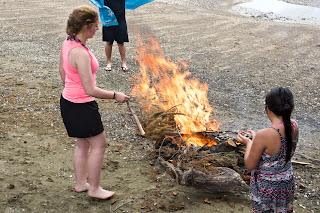
I was fortunate to be asked to go on the the 4 day trip to Rawhiti Marae in November. I went with about 20 Māori students from Kata O'Donnell's tutor class and 3 other teachers. The purpose of the trip was to familiarise the students with Māori tikanga in a remote settlement on Māori land which is quite different from what they are accustomed to. Activities were run by WaiNot Tourism and featured a forest walk, snorkelling, fishing with nets, cooking pippis on the beach, swimming and jet ski riding. The students were kept busy from 7.45am until about 10pm at night. It was a great way for them to bond together well away from school and to have new experiences learning new skills. What did I learn from This? I learned more about ways of working with Māori students,the importance of tikanga, eating, sleeping and working together. It was fascinating to be in such a remote untouched environment and to see how the students behaved and related differently fro...

Learners leading learning

Image
For our PCT professional learning yesterday we looked at the reading "Learners in the Driving Seat" by Chris Watkins . Watkins begins the reading with asking the students to point their index finger to the ceiling then to point to who is responsible for their learning. Most will point to the teacher. This is certainly the case with the 11 beginning teachers that I am currently working with ie that they take responsibility for the students' learning but as Watkins points out " research demonstrates that when students are driving the learning it leads to: greater engagement & intrinsic motivation students setting higher challenges students evaluating their own work (self & peer assessment) better problem-solving" He then provides some very good questions to ask (rather than tell) for Before Starting, On the Road, and Journey's end. These equate well to John Hattie's feedback questions "Where am I going?" (Learning Intention/g...

Behaviour Management

Image
I have spent a number of years running workshops for & mentoring PRTs now PCTs. Behaviour Management was always the thing that they struggled with in their first year. The answer is always in developing learning-focused relationships. The PCTs have been attending PLD on Positive Behaviour for Learning run by the local RTLB Service. Following are some great diagrams on de-escalating behaviour in the classroom. The big question - how do your actions escalate or de-escalate the situation. Generally, if the teacher remains calm, the class will remain calm & vice versa.

Teaching Tongan Students

Image
Mele Suipi Latu, a teacher on the staff at Tamaki College, ran a session for us on Tongan values, ways of being and how these are sometimes in conflict with what we expect of them in school. She reminded us that students come to school already shaped with a whole world view consisting of beliefs, customs, practices, and expectations. The 4 Tongan values: Respect Relationships - family, church, country, villages Humility - Lototo - drop what you want and go with expectations. Everyone knows their place. Commitment - you do it until it hurts. Commit to whatever course you are doing. Students develop a subculture when they leave home - a second culture. There can be a clash between the subculture of school & home. At home they learn to do what they are told and to respect their elders; at school they are taught to question. Mele suggests that the teacher puts up their expectations from the first lesson but should never disown the students from their culture. There can be...

Classroom Management

The advantage of working with trainee teachers (Teach First teachers) when you have been teaching for a long time is that it takes you back to the beginnings of things like classroom management 1.01 and behaviour management basics. Building Relationships and Expectations are crucial in the first few weeks.  Tamaki College has a set of values called RISE (Respect, Integrity, Success, Responsibility) which are embedded into the vision and ways of working in the school. The students are familiar with these and they work well. The teacher will also set other expectations to do with behaviour, work, tools, listening and following instructions. These will all enable the development of positive relationships between teacher and students and so make the teaching and learning more productive. See building relationships with Pasifika students here  and with Māori students here . Setting up a routine and sticking to it is also crucial to developing a good and safe physical and e...